Meditation Therapy for Addiction & Anxiety
Recovery asks a lot of you — and not just in therapy sessions. It asks you to sit with discomfort, interrupt patterns that have felt automatic for years, and build a different relationship with your own thoughts and emotions. Meditation therapy is one of the most practical tools we use to support that process.
At Silver Lining Recovery, meditation is not an add-on or a wellness bonus. It is a clinically integrated component of treatment — used alongside individual therapy, group therapy, and evidence-based modalities like DBT to help you build the inner steadiness that lasting recovery requires.
Want to learn how meditation therapy fits into your treatment plan? Call (866) 681-0927 or verify your insurance online — no commitment required.
Table of Contents
What Is Meditation Therapy?
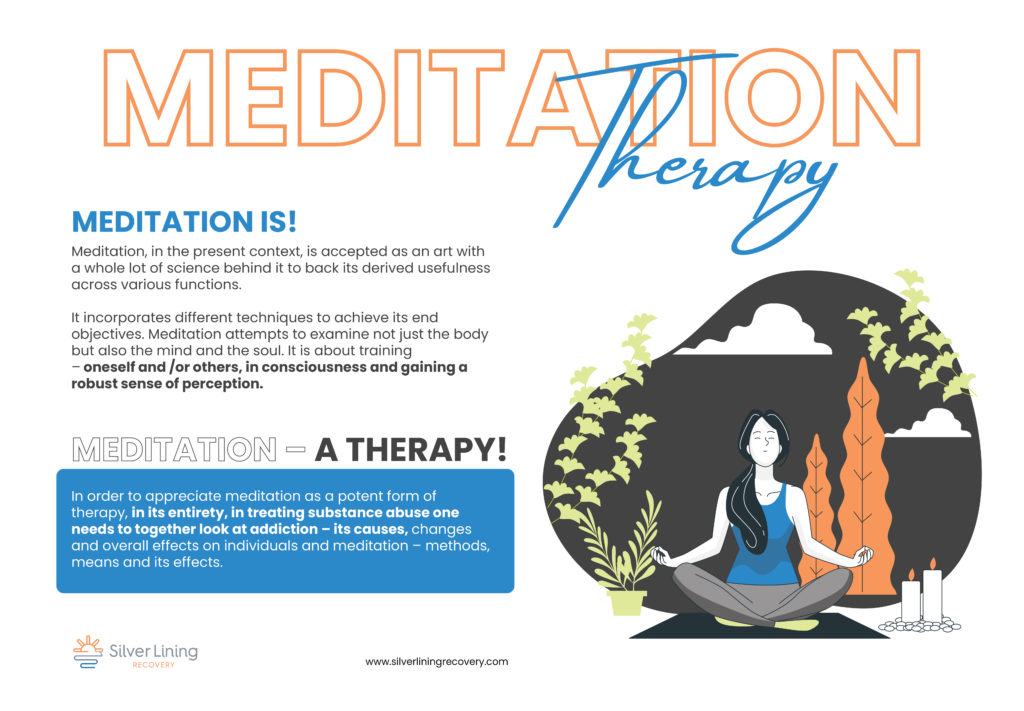
Meditation therapy is the structured, intentional use of meditation practices within a clinical treatment setting. It is distinct from general wellness meditation or guided relaxation apps — here, meditation is used with specific therapeutic goals in mind, facilitated by trained clinicians who understand how it intersects with addiction, trauma, and mental health.
The practice teaches you to observe your thoughts, emotions, and physical sensations without immediately reacting to them. Over time, that pause between stimulus and response becomes one of the most powerful tools in recovery — the space where a craving doesn’t have to become a relapse, and where anxiety doesn’t have to become avoidance.
At Silver Lining Recovery, meditation therapy is woven into both individual and group treatment formats at every level of care, from Partial Hospitalization (PHP) through Intensive Outpatient (IOP) and standard outpatient.
How Meditation Supports Recovery
Addiction and anxiety share a common neurological thread: both involve the brain’s stress response system working in overdrive. Substances often begin as a way to quiet that system — and over time, the brain comes to depend on them to regulate what feels unmanageable.
Meditation works on that same system through a different pathway. Regular practice has been shown to influence the brain’s neurotransmitter activity — supporting the natural production of calming and mood-regulating chemicals that substance use can disrupt. It also activates the parasympathetic nervous system, shifting the body out of the chronic fight-or-flight state that many people in early recovery experience.
In practical terms, consistent meditation practice in a treatment context can support:
- Craving awareness and interruption — recognizing the onset of a craving as a passing mental event rather than an emergency that requires immediate action
- Stress and anxiety reduction — lowering baseline physiological arousal so that triggers feel less overwhelming
- Emotional regulation — building the capacity to experience difficult emotions without being governed by them
- Sleep quality — reducing the racing thoughts and hypervigilance that disrupt sleep in early recovery
- Relapse prevention — developing the mindful self-awareness to catch high-risk emotional states early
- Focus and mental clarity — restoring concentration and present-moment attention that substance use can erode
All efficacy language above reflects general research directions. Silver Lining Recovery uses probabilistic clinical framing — meditation therapy may support these outcomes; individual results vary.
Types of Meditation Used in Treatment
Meditation therapy is not one technique — it is a family of practices, each with different mechanisms and applications. At Silver Lining Recovery, the approach is matched to your clinical needs and comfort level. You don’t need prior experience with any of these.
Mindfulness Meditation
Mindfulness meditation is the practice of placing focused, non-judgmental attention on the present moment — typically the breath, body sensations, or immediate surroundings. It is the foundation of the DBT mindfulness module and one of the most research-supported practices in addiction treatment.
For people in recovery, mindfulness can be transformative: it creates the awareness to notice a trigger, a craving, or an emotional shift before it drives behavior — giving you a moment of choice where there previously felt like none.
Breath Awareness
Breath awareness practices use the rhythm of breathing as an anchor for attention and a direct tool for nervous system regulation. Slow, deliberate breathing activates the vagus nerve and can produce measurable reductions in anxiety and physiological stress within minutes.
This is often the first practice introduced to clients in treatment — it’s accessible, requires no prior experience, and can be used discreetly in any environment when distress rises.
Body Scan
A body scan is a guided practice in which attention moves slowly through different regions of the body, noticing sensations without trying to change them. For people carrying unprocessed trauma, the body scan can be a gentle entry point into somatic awareness — learning to be present in the body without feeling threatened by what’s there.
This practice is often used in coordination with trauma-informed therapy at Silver Lining, supporting the work done in individual sessions.
Guided Visualization
Guided visualization uses structured mental imagery to support emotional processing, stress reduction, and the rehearsal of healthy coping responses. A clinician or facilitator leads the practice, making it particularly accessible for clients who find silent meditation difficult in early treatment.
It can be used to rehearse handling high-risk situations, to access a sense of safety and calm, or to support goal-setting and motivational work.
Loving-Kindness Meditation (Metta)
Loving-kindness meditation involves the deliberate cultivation of warmth and compassion — first toward yourself, then toward others. For many people in recovery, self-criticism and shame are significant barriers to sustained engagement with treatment.
This practice directly addresses that. It is not about forced positivity — it is a structured method for gradually shifting the internal narrative from one of self-condemnation to one of self-support.
How Meditation Therapy Works at Silver Lining Recovery

Individual Practice
Meditation techniques are introduced and practiced within your individual therapy sessions, where your therapist can tailor the approach to your specific clinical needs — whether that’s managing anxiety, processing trauma, building distress tolerance, or improving sleep. Home practice is encouraged between sessions and supported with guidance on how to build a sustainable routine.

Group Meditation Practice
At Silver Lining, you can also engage in meditation as part of a facilitated group setting — which adds a layer of accountability, shared experience, and community that individual practice alone doesn’t provide. It is common to find the practice easier to sustain when you’re practicing alongside others who are working through similar challenges.
Group meditation sessions are structured, clinician-led, and integrated into the PHP and IOP weekly schedules. Getting comfortable with your own mind takes time, and the group context helps normalize the difficulty of that process.
Integrated Into Your Full Treatment Plan
Meditation therapy at Silver Lining doesn’t exist in a silo. It connects directly to your work in DBT skills training — particularly the mindfulness module — and supports the emotional processing that happens in trauma-informed therapy and CBT. Your care team coordinates across all modalities to ensure these practices reinforce each other.
What Meditation Therapy Can Help With
Lorem ipsum dolor sit amet, consectetur adipiscing elit. Ut elit tellus, luctus nec ullamcorper mattis, pulvinar dapibus leo.
-
Substance use disorders and addiction
-
Anxiety and panic disorders
-
Chronic stress and burnout
-
Sleep disruption and insomnia
-
Cravings and relapse triggers
-
Emotional dysregulation
-
Depression and low mood
-
PTSD and trauma responses
-
Co-occurring dual-diagnosis conditions
-
Anger and impulse control
-
Low self-worth and chronic self-criticism
-
Difficulty being present or grounded
If you’re unsure whether meditation therapy is appropriate for what you’re experiencing, our clinical team can help you figure out how it fits — or doesn’t — into the right treatment approach for you.
Meditation Therapy vs. Meditation Apps
Many people arriving at this page have already tried meditation through an app or on their own — and may have found it difficult to sustain, or wondered whether it was actually helping. That’s worth addressing directly.
Self-guided meditation apps can be a useful supplement for people who already have some stability. What they can’t provide is clinical context: a therapist who understands your diagnosis, your trauma history, and the specific emotional patterns that are keeping you stuck — and who can tailor the practice accordingly.
In a treatment setting, meditation isn’t a generic wellness practice.
The type of meditation introduced, the pacing, the way it’s integrated with your other therapy, and the support available when the practice brings up difficult material — all of that is calibrated to you. That clinical scaffolding is what makes meditation therapy meaningfully different from an app.
We Accept Most Major Insurance Plans
Meditation therapy is delivered as part of Silver Lining’s outpatient treatment programs, which are covered by most major insurance plans. The Mental Health Parity and Addiction Equity Act requires insurers to cover mental health and substance use treatment at the same level as medical care.
We work with most major insurance providers, including Aetna, Anthem Blue Cross, Blue Shield of California, Cigna, Health Net, and TRICARE.







Not sure what your plan covers? Our admissions team will verify your benefits quickly — often the same day — at no charge and with no obligation to enroll.
What to Expect When Starting Meditation Therapy
Step 1: Confidential Intake Call
Your first conversation with us is free, private, and without pressure. Our admissions team will ask about what you’re going through, explain your treatment options, and verify your insurance. No prior experience with meditation is needed — and no referral is required.
Step 2: Clinical Assessment
A licensed clinician will complete a full biopsychosocial assessment before treatment begins — reviewing your substance use history, mental health background, stress patterns, sleep, and goals. This determines your level of care and which combination of therapeutic modalities, including meditation, is the right fit.
Step 3: Meditation Integrated Into Your Treatment Plan
If meditation therapy is part of your plan, your clinician will introduce practices gradually and at a pace that works for you. You’ll learn how each technique connects to your specific treatment goals, and receive guidance on practicing between sessions.
Step 4: Ongoing Practice and Aftercare
Meditation is one of the few therapeutic tools that genuinely transfers into the rest of your life. As treatment progresses, your care team will help you build a sustainable personal practice — one you can maintain as you step down in care and continue your recovery long-term.
What to Expect When Starting Meditation Therapy
No experience is needed at all. Practices are introduced gradually, starting with the most accessible techniques. Your clinician will guide you through each one and adjust based on what feels manageable.
Not in the way it’s practiced at Silver Lining Recovery. The meditation techniques used in our clinical programs are evidence-informed and secular. Some practices — like loving-kindness meditation — have roots in Buddhist traditions, but they are taught here as psychological tools, not spiritual ones. If you have a personal faith practice, that can be honored alongside this work.
That’s one of the most common concerns people have — and it’s based on a misconception about what meditation actually is. The goal is not to stop thinking. It’s to notice that you’re thinking, and gently return your attention. A busy mind in meditation is not a failure — it’s the practice itself.
Apps offer guidance but not clinical context. In treatment, the type of meditation, the pacing, and the integration with your other therapy are all tailored to your diagnosis and goals. You also have support when the practice surfaces difficult material — something an app can’t provide.
Yes — that’s exactly how it’s designed to work. Meditation is integrated into your broader treatment plan alongside individual therapy, group therapy, DBT, trauma-informed work, and other modalities. It is not a standalone program.
Meditation therapy is delivered as part of Silver Lining’s outpatient treatment programs, which are covered by most major insurance plans. Our admissions team will verify your specific benefits at no cost to you — usually within 24 hours.
Take the Next Step Toward Recovery
Our admissions team is available 7 days a week to answer your questions, verify your insurance, and help you understand how meditation therapy fits into a treatment plan designed for you.

Clinically Reviewed By
Last reviewed: June 11, 2026
Sarah is a Licensed Clinical Social Worker (LCSW) and Primary Therapist specializing in the treatment of substance use disorders, co-occurring mental health conditions, trauma, and attachment-related challenges. She is EMDR-trained and utilizes a trauma-informed, attachment-based approach to help clients understand how past experiences shape present…