
EMDR Therapy: Eye Movement Desensitization and Reprocessing
- Evidence-Based Treatment
- Trauma-Focused Therapy
- Licensed Clinical Care
- PTSD & Anxiety Support
- Insurance Accepted
- Huntington Beach, CA
EMDR therapy at Silver Lining Recovery helps individuals process traumatic memories and break the cycle of addiction through evidence-based, structured treatment. Our licensed clinical team integrates EMDR into a full continuum of care — including PHP, IOP, and outpatient programs — to address both trauma and co-occurring substance use disorders.

How EMDR Therapy Supports Trauma & Addiction Recovery
Trauma shapes how people think, feel, and respond to the world around them. Experiences of abuse, neglect, or emotional distress can lead to lasting repercussions — including addiction, chronic low self-esteem, and mental illness. EMDR therapy offers a structured, evidence-based path to address those root causes.
EMDR therapy is a well-established psychotherapy originally developed for PTSD. Clinical evidence now supports its effectiveness across a range of conditions, including anxiety, addiction recovery, chronic pain, and phobias.
Explore how EMDR therapy at Silver Lining Recovery can help you process traumatic memories, replace negative emotions with positive ones, and foster healthier habits and relationships. Discover a path to healing and transformation today.
What Is EMDR Therapy and How Does It Work?
EMDR was developed by Dr. Francine Shapiro and uses guided eye movements and bilateral stimulation to help individuals release negative associations tied to traumatic memories. It was originally designed to treat post-traumatic stress, anxiety, and phobias.
How EMDR Works: The Adaptive Information Processing Model
EMDR therapy relies on the Adaptive Information Processing (AIP) model, developed by Dr. Francine Shapiro. This model holds that the mind — like the body — has a natural ability to heal from psychological wounds. When that process is disrupted, trauma becomes “stuck.”
During a traumatic event, the brain’s normal information processing can be overwhelmed by intense emotion. Memories then get stored without proper context or connections, leaving them as unresolved fragments. These incompletely processed memories are linked to conditions like PTSD, addiction, chronic pain, and phobias.
When new associations connect to already-stored memory networks, learning and healing take place. EMDR works by facilitating those connections — allowing the brain to complete the processing it couldn’t finish during the original trauma.
What Happens During an EMDR Session?
EMDR therapy sessions involve revisiting traumatic experiences or triggers in brief, controlled doses, as agreed upon with your therapist. During these sessions, the therapist uses hand movements and other tactile techniques to guide the individual’s eye movements side by side. This may include viewing a pendulum swing or hand tapping, among other sensory inputs.
The goal of Eye Movement Desensitization and Reprocessing (EMDR) therapy is to process dysfunctional memories by linking them to more adaptive information. This process helps reframe the experience with appropriate emotions, allowing the person to understand and process past encounters in a safe environment. Negative emotions are gradually replaced by positive sentiments, promoting healthier habits and relationships.
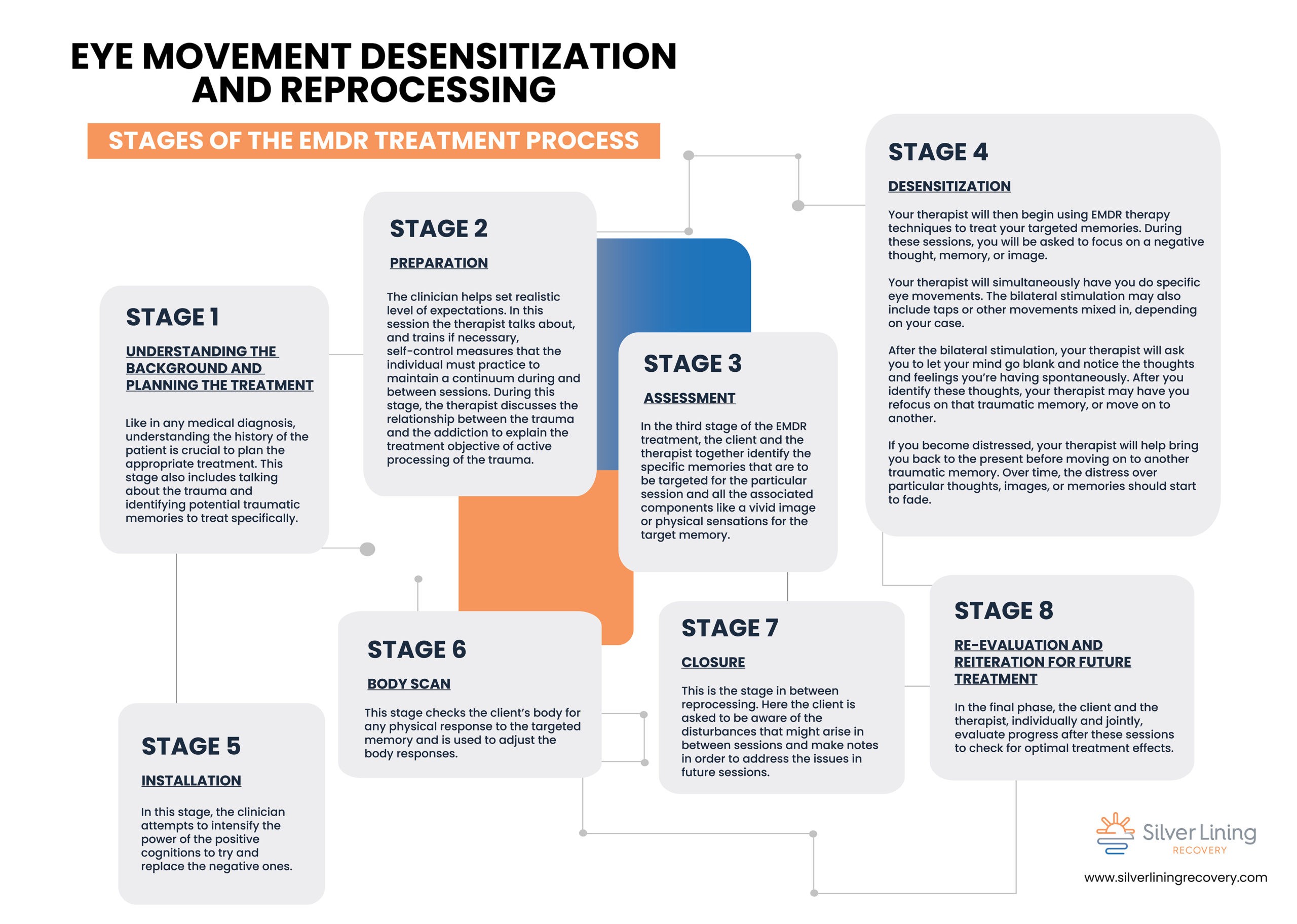
8 Stages of the EMDR Treatment Process
EMDR therapy follows a structured eight-stage process designed to guide clients safely from trauma assessment through full emotional reprocessing. Each stage builds on the last, ensuring that painful memories are addressed thoroughly and that clients feel supported at every step.
Stage 1: Understanding the Background and Planning the Treatment
Treatment begins with a thorough history-taking session where the therapist learns about the client’s background, trauma experiences, and mental health history. Together, the client and therapist identify specific traumatic memories to target throughout the course of treatment. This foundation ensures the entire process is personalized and clinically appropriate.
Stage 2: Preparation
In the preparation stage, the therapist sets realistic expectations and teaches self-regulation techniques the client can use during and between sessions. The connection between trauma and addiction is discussed openly, so clients understand why active processing of traumatic memories is central to recovery.
Stage 3: Assessment
During the assessment stage, the client and therapist identify the specific memories to be targeted in that session. Associated components — such as related images, negative beliefs, emotions, and physical sensations — are mapped out to ensure precise and effective processing.
Stage 4: Desensitization
Desensitization is the core processing stage of EMDR therapy. Your therapist guides you to focus on a targeted traumatic memory while simultaneously directing bilateral stimulation — such as guided eye movements, hand tapping, or other sensory inputs.
After each round of bilateral stimulation, your therapist will ask you to clear your mind and observe what thoughts or feelings arise naturally. Over multiple repetitions, the emotional charge attached to the memory gradually reduces, allowing the brain to reprocess it in a healthier way.
Stage 5: Installation
The installation stage focuses on strengthening positive beliefs to replace the negative cognitions associated with traumatic memories. Once distress around a memory has been reduced, the therapist helps the client anchor new, adaptive thoughts in its place.
Stage 6: Body Scan
After reprocessing a memory, the therapist guides the client through a body scan to identify any remaining physical tension or discomfort. If residual sensations are detected, additional processing is done until the body’s response feels neutral and settled.
Stage 7: Closure
Closure brings each session to a calm, stabilized end — regardless of whether full reprocessing was completed. Clients are encouraged to note any disturbances or emotions that arise between sessions so they can be addressed in future appointments.
Stage 8: Re-Evaluation and Reiteration for Future Treatment
In the re-evaluation phase, the client and therapist jointly review progress and assess the effectiveness of previous sessions. This stage ensures that all targeted memories have been fully processed and guides planning for any remaining treatment needs.
Our Approach to EMDR at Silver Lining Recovery
At Silver Lining Recovery in Orange County, California, our EMDR treatment program is built around a holistic, client-centered philosophy. Every aspect of care is designed to support lasting healing — emotionally, socially, and cognitively.
- Create a safe, supportive environment for self-exploration and emotional processing
- Guide clients through self-reflection, open discussion, and collaborative healing
- Address the whole person — socially, physically, emotionally, creatively, and cognitively
- Build trusting, therapeutic relationships that foster genuine recovery
- Involve family members as valued partners in the healing process
- Track and document each client’s progress to continuously improve care
Together, these principles support clients as they move through the stages of healing — from confronting deep-rooted negative beliefs to building a foundation of acceptance, resilience, and lasting positivity.
Eye Movement Desensitization and Reprocessing therapy is an eight-stage treatment.
Stage 1: Understanding the background and planning the treatment
Like in any medical diagnosis, understanding the history of the patient is crucial to plan the appropriate treatment. This stage also includes talking about the trauma and identifying potential traumatic memories to treat specifically.
Stage 2: Preparation
The clinician helps set realistic level of expectations. In this session the therapist talks about, and trains if necessary, self-control measures that the individual must practice to maintain a continuum during and between sessions. During this stage, the therapist discusses the relationship between the trauma and the addiction to explain the treatment objective of active processing of the trauma.
Stage 3: Assessment
In the third stage of the EMDR treatment, the client and the therapist together identify the specific memories that are to be targeted for the particular session and all the associated components like a vivid image or physical sensations for the target memory.
Stage 4: Desensitization
Your therapist will then begin using EMDR therapy techniques to treat your targeted memories. During these sessions, you will be asked to focus on a negative thought, memory, or image.
Your therapist will simultaneously have you do specific eye movements. The bilateral stimulation may also include taps or other movements mixed in, depending on your case.
After the bilateral stimulation, your therapist will ask you to let your mind go blank and notice the thoughts and feelings you’re having spontaneously. After you identify these thoughts, your therapist may have you refocus on that traumatic memory, or move on to another.
If you become distressed, your therapist will help bring you back to the present before moving on to another traumatic memory. Over time, the distress over particular thoughts, images, or memories should start to fade.
Stage 5: Installation
In this stage, the clinician attempts to intensify the power of the positive cognitions to try and replace the negative ones.
Stage 6: Body Scan
This stage checks the client’s body for any physical response to the targeted memory and is used to adjust the body responses.
Stage 7: Closure
This is the stage in between reprocessing. Here the client is asked to be aware of the disturbances that might arise in between sessions and make notes in order to address the issues in future sessions.
Stage 8: Re-evaluation and reiteration for future treatment
In the final phase, the client and the therapist, individually and jointly,evaluate progress after these sessions to check for optimal treatment effects.
At Silver Lining, the process measures that we ardently follow during the implementation of EMDR treatment at our Orange County, California, facility are aimed to support quality programs that:
- Provide the conducive environment to our patrons to initiate and facilitate the self-exploration process.
- Assists our clinicians to help individuals in self-reflection, discussion, and building of continuing collaborations among the healing population.
- Focus on an individual’s holistic healing in all spheres of their life – social, physical, emotional, creative and cognitive.
- Establish receptive and positive relationships.
- Engage with their families and learn to appreciate their unique perspectives and contributions.
- Use documentation to study, interpret and make visible the healing process of individuals.
These approaches support the individuals as they learn to accept and move beyond their own deep-rooted negative beliefs along a developmental continuity and make way for a smoother transition from negativity to acceptance to ultimate positivity.

Who Is a Good Candidate for EMDR Therapy?
EMDR therapy is effective for individuals dealing with trauma, PTSD, anxiety, addiction, and co-occurring disorders. It works best for those who have some distress tolerance and are ready to begin processing difficult memories. If you’re unsure whether EMDR is right for you, our clinical team in Huntington Beach can help assess your needs.
EMDR Therapy and Addiction Recovery?
Addiction and trauma are deeply connected — unresolved traumatic memories are often at the root of substance use. EMDR therapy targets those underlying emotional wounds, making it a powerful complement to addiction treatment programs like PHP and IOP. At Silver Lining Recovery, EMDR is integrated directly into our continuum of care for lasting results.
Start Your Healing Journey Today
If you or a loved one are struggling with the aftermath of trauma, PTSD, or emotional distress, Eye Movement Desensitization and Reprocessing (EMDR) therapy at Silver Lining Recovery can provide the support and relief you need. Our compassionate team is dedicated to helping you process difficult memories, replace negative emotions with positive ones, and develop healthier habits and relationships.
Don’t let past experiences control your future. Take the first step towards healing and transformation. Contact us today to learn more about our EMDR therapy program and schedule a consultation. Your path to a brighter, healthier future begins here.
Reach out to Silver Lining Recovery now to start your journey towards healing.
Call us at 949-627-8364 to schedule your consultation today.

Clinically Reviewed By
Last reviewed: June 11, 2026
William Sanchez, LMFT, is a licensed marriage and family therapist at Silver Lining Recovery, specializing in helping clients address the underlying causes of addiction.