
Mental health diversion under California Penal Code 1001.36 lets a court pause a criminal case, place an eligible defendant into approved mental health treatment, and dismiss the charges if that treatment is completed successfully. Eligibility turns on a qualifying diagnosis, a link between the disorder and the alleged offense, and the specific charge involved.
Key Takeaways
- It covers felonies and misdemeanors. The statute applies to a misdemeanor or felony offense that isn’t on the excluded list, so a felony charge doesn’t rule you out by itself.
- A diagnosis alone won’t qualify you. You need a qualifying DSM diagnosis made or treated within the last five years, plus a finding that the disorder was a significant factor in the offense.
- How long it runs depends on the charge. Diversion lasts no longer than two years on a felony and one year on a misdemeanor.
- The rules change on January 1, 2027. AB 46, signed in June 2026, broadens the public safety test judges apply and lets courts weigh whether a treatment plan is clinically appropriate.
- Finishing it dismisses the case. The court dismisses the charges, the arrest is deemed never to have occurred, and record access is restricted.
If you’re facing charges and a mental health condition is part of the picture, diversion is one of the few places in the system where getting treatment and resolving your case point the same direction.
The legal strategy belongs to your attorney. The treatment side is where we come in, and Silver Lining Recovery runs the outpatient programs that can satisfy a court-ordered treatment requirement in Orange County.
What diversion actually means for your case
PC 1001.36 is a pretrial diversion statute. Your case gets postponed instead of tried, and you enter a treatment plan the court approves and keeps an eye on.
Diversion isn’t a plea, a conviction, or a civil commitment. The judge holds onto your case for the whole diversion period and can restart the prosecution if the plan falls apart.
Worth knowing the history: SB 1223 rewrote the statute in 2022 and split the analysis into two stages. Eligibility is mostly factual. Suitability is where a judge’s discretion lives.
Do you qualify?
You have to clear both stages. Eligibility is the threshold question, and suitability is where the court decides whether diversion actually makes sense in your case.
What the court has to find
| Stage | Requirement | What the court is looking for |
|---|---|---|
| Eligibility | Qualifying mental disorder | A DSM diagnosis such as bipolar disorder, schizophrenia, schizoaffective disorder or PTSD. Antisocial personality disorder, borderline personality disorder and pedophilia do not qualify. |
| Eligibility | Diagnosis within five years | Evidence of diagnosis or treatment within the last five years by a qualified mental health expert. |
| Eligibility | Significant factor in the offense | The court shall find the disorder was a significant factor unless there is clear and convincing evidence it was not a motivating, causal or contributing factor. |
| Eligibility | Charge is not excluded | The offense is not one of the categorically excluded charges listed below. |
| Suitability | Symptoms would respond to treatment | An opinion from a qualified mental health expert that the symptoms driving the conduct are treatable. |
| Suitability | Consent and waiver | You consent to diversion and waive your right to a speedy trial. |
| Suitability | Agreement to comply | You agree to the treatment conditions the court sets. |
| Suitability | Public safety | Through 2026, whether you pose an unreasonable risk of danger to public safety, measured against the likelihood of committing a “super strike” offense. From January 1, 2027, a broader test under AB 46. |
“Significant factor in the offense” is the one most people miss, and it works in your favor. Once a qualifying diagnosis is on the table, the burden shifts, and the prosecution has to prove by clear and convincing evidence that your disorder wasn’t a factor.
The charges that rule it out
Some charges are off the table no matter how strong the clinical picture is. The list covers murder and voluntary manslaughter, rape, and sex offenses requiring registration under PC 290.
Also excluded: lewd or lascivious acts on a child under 14, assault with intent to commit rape or a related offense under PC 220, rape or sexual penetration in concert under PC 264.1, continuous sexual abuse of a child under PC 288.5, and weapons-of-mass-destruction offenses under PC 11418(b) or (c).
DUI offenses are barred separately, under Vehicle Code section 23640. If your charge is anywhere near this list, get a direct read from your attorney before you spend money on an evaluation.
If substance use is part of your story, a co-occurring substance use disorder doesn’t disqualify you. Courts generally want to see a plan that treats the substance use and the mental health condition together rather than one after the other.

How long it lasts, and how it ends
| Scenario | Maximum period | What the court does | Outcome |
|---|---|---|---|
| Misdemeanor charge | No longer than one year | Periodic review hearings and provider progress reports | Charges dismissed on satisfactory performance |
| Felony charge | No longer than two years | Periodic review hearings, often with probation monitoring | Charges dismissed on satisfactory performance |
| Excluded charge | Not available | No diversion analysis reached | Case proceeds normally |
| Non-qualifying diagnosis only | Not available | Eligibility fails at the first stage | Case proceeds normally |
| Non-compliance during diversion | Diversion may be terminated | Court holds a hearing on performance | Criminal proceedings may resume |
Finish successfully and the court dismisses your charges, the arrest is deemed never to have occurred, and access to the record is restricted. A few disclosure obligations survive, including applications for peace officer positions, so ask your attorney what the dismissal does and doesn’t do for you specifically.
Within those caps, everything else depends on your county, the court’s calendar, and how fast an evaluation and a treatment plan come together. Any provider promising you a guaranteed turnaround is guessing.
What changes on January 1, 2027
Governor Newsom signed AB 46 on June 29, 2026, and it takes effect January 1, 2027. It’s the biggest change to mental health diversion since the 2022 rewrite, and most pages explaining this statute haven’t caught up to it yet.
Two shifts matter if you’re planning a petition.
The public safety test gets broader. Right now a judge asks whether you pose an unreasonable risk of committing a narrow set of “super strike” offenses. AB 46 swaps that for a wider question: whether you pose a substantial and undue risk to the physical safety of another person. Judges get more room to say no.
Your treatment plan comes under review. Courts will be able to weigh whether the plan in front of them is clinically appropriate for you. A plan naming a real provider, a specific level of care and a realistic schedule is going to land better than one describing treatment in the abstract.
AB 46 also keeps the five-year diagnosis window and tightens documentation and oversight. A separate bill, SB 1373, would narrow eligibility further, but it stalled in committee in August 2026 and isn’t law.
One honest caveat about all of this: nobody has great statewide data. California’s Council on Criminal Justice and Behavioral Health found that 44 of 52 responding counties, about 85 percent, run some form of diversion program.
Not sure which program is right for you? Our admissions team is here to help — 100% confidential, no obligation.
Get Help Today →The same report notes there’s very limited statewide data on how many people get evaluated, accepted or denied. If you see a site quoting California diversion completion rates, they’re quoting numbers the state says it doesn’t have.
What the process looks like in Orange County
County practice is where the statute meets the actual courthouse, and Orange County publishes its own procedural guidelines. Everything below comes from those guidelines rather than general commentary.
Getting the petition filed
Your defense counsel files the motion electronically with the court’s mental health diversion inbox and serves the District Attorney’s dedicated mental health address. The motion needs the proposed treatment plan and your eligibility evidence attached when it goes in, not promised for later.
Initial hearings get calendared as soon as practicable on a Tuesday morning. Contested hearings are heard Tuesday afternoons or on Thursdays.
The evaluation the court leans on
A qualified mental health expert documents your diagnosis, confirms it falls inside the five-year window, and gives an opinion on whether your symptoms would respond to treatment. The same expert usually addresses whether treating you in the community would create a public safety risk.
A forensic evaluation like that is usually arranged through your attorney rather than through a treatment provider. Our involvement generally starts once a level of care is on the table, with a clinical assessment at intake and the reporting the court expects after that.
The treatment plan a judge will sign off on
Orange County wants a treatment plan built around your individual needs in place before diversion begins. From January 2027, how clinically appropriate that plan is becomes something the court can weigh directly, which makes your choice of provider a bigger decision than it used to be.
Most approved plans are outpatient. Outpatient care lets you keep working, keep your housing and stay with your family, which is usually the whole point of diverting someone in the first place.
Staying on track once you start
Providers send progress reports to the court, the prosecutor and your defense counsel no later than the Monday before each Thursday review hearing. Reports go out on that rhythm for as long as your diversion runs.
Showing up consistently, and telling your treatment team quickly when something goes wrong, is what keeps a diversion on track. Missed sessions nobody hears about are what put it at risk.
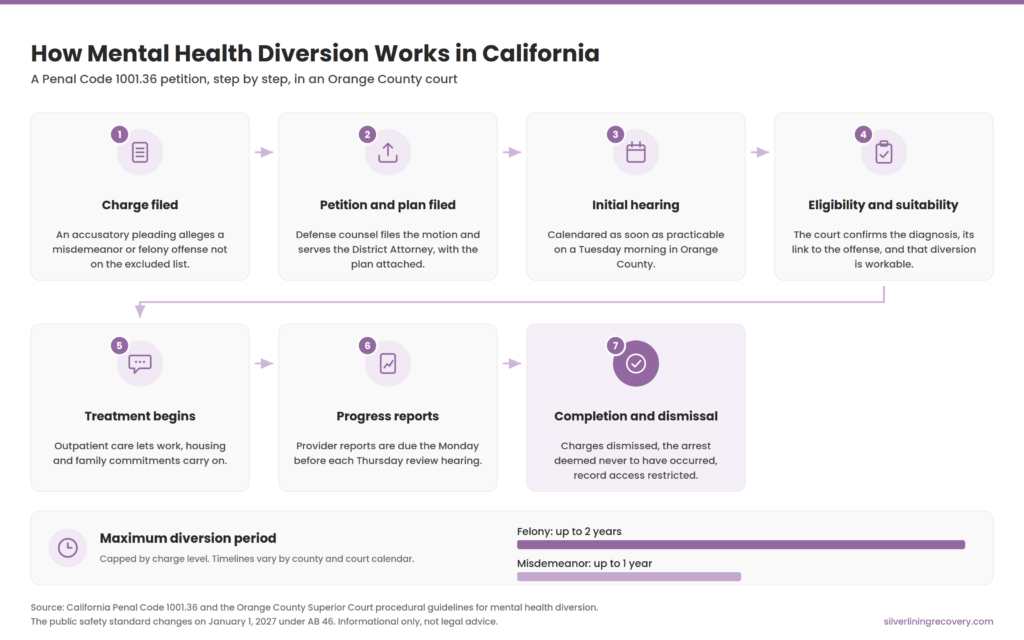
Figure: how a PC 1001.36 petition moves through an Orange County court. Source: California Penal Code 1001.36 and Orange County Superior Court procedural guidelines.
Where we fit in

We’re an outpatient provider in Huntington Beach, serving Los Angeles, Orange and Riverside counties. In a diversion case our job is the treatment itself and the reporting that goes with it.
Programs that can meet a court’s requirement
Our partial hospitalization program in Huntington Beach is the most structured care we offer, for people who need substantial clinical contact while still sleeping at home. Stepping down from there, our intensive outpatient program schedule runs structured group and individual work several days a week.
Holding down a job through your case? Evening IOP for working adults meets after business hours. Our virtual IOP available across California reaches people who can’t reliably get to Huntington Beach, which matters when transportation is part of why someone missed court to begin with.
If you’re not sure which level fits, our guide to how outpatient levels of care compare is worth ten minutes before you sit down with your attorney.
One thing to be clear about: we’re outpatient only. We don’t operate a detox unit or a residential facility, and if you need medical detox first, we’ll help you connect with a licensed program.
Paying for it is its own subject, and we’ve covered it properly elsewhere. Our guide to how court-ordered treatment gets paid for walks through private insurance, Medi-Cal, county funding and what Proposition 36 changed in Orange County.
Dual diagnosis, trauma and veterans
Diversion cases very often involve a mental health condition and substance use at the same time. Our co-occurring mental health and substance use care treats both together, using trauma-informed approaches including EMDR, CBT and DBT where they fit clinically.
Our veterans and active military track is staffed by clinicians who understand military culture, and PTSD is a qualifying diagnosis under the statute. Our broader outpatient mental health services cover depression, anxiety and related conditions.
Ready to take the first step toward recovery? We’re available 24/7.
What we can and can’t share with the court
Bring your court paperwork and anything your probation officer gave you to your assessment, and we’ll walk through the requirement with you before you enroll. Your attendance and clinical progress get recorded in your treatment record.
Releasing any of it to a court, probation officer or attorney takes your written authorization first. Substance use records carry confidentiality protections that go beyond standard medical privacy.
Insurance
We work with most major providers. Nobody, us included, can confirm what your plan covers until benefits verification is done, so verify your benefits before enrolling rather than assuming.
Frequently asked questions
Are there new restrictions on mental health diversion in California?
Yes. AB 46 was signed on June 29, 2026 and takes effect January 1, 2027. It broadens the public safety test judges apply and lets courts consider whether a proposed treatment plan is clinically appropriate. Local screening practice also varies by courthouse, which is why outcomes differ from county to county.
Does mental health diversion apply to felonies?
Yes. The statute covers a misdemeanor or felony offense that isn’t on the excluded list. Felony diversion is capped at two years, misdemeanor diversion at one year.
Does a mental health diagnosis by itself qualify me?
No. You need a qualifying DSM diagnosis made or treated within the last five years, plus a finding that the disorder was a significant factor in the charged offense, plus the suitability findings. Antisocial personality disorder, borderline personality disorder and pedophilia are excluded as qualifying diagnoses.
What’s the difference between a 5150 hold and diversion?
A 5150 is a 72-hour involuntary psychiatric hold under the Welfare and Institutions Code, and a 5250 is a 14-day extension of it. Both are civil, and neither one is part of a criminal case. Diversion is a criminal-court process, and records from a hold can help evidence your diagnosis without substituting for the statutory findings.
Can a veteran with PTSD use mental health diversion?
Yes. PTSD is a qualifying diagnosis, assuming the link to the offense is established and no exclusion applies. California also has a separate diversion pathway specific to military service, and your attorney can advise which route fits you better.
Does a substance use disorder disqualify me?
No. Substance use alongside a qualifying mental health diagnosis usually calls for an integrated treatment plan rather than disqualification, and courts commonly approve outpatient plans that address both.
Can diversion be revoked?
Yes. A court can end diversion for non-compliance and restart criminal proceedings. Showing up, engaging honestly, and having a provider who files progress reports on the court’s schedule are your practical protections against that.
Talk to our admissions team
If your attorney needs a treatment provider who understands what a diversion court expects, we can walk you through levels of care, scheduling and documentation, and start benefits verification the same day you reach out.
Call (866) 681-0927 or contact our Huntington Beach admissions team for a free, confidential assessment.
This content is for informational purposes only and is not legal advice or a substitute for professional medical advice, diagnosis or treatment. Eligibility for diversion is decided by a court on the facts of each case. Consult a qualified attorney about your charges and a qualified healthcare provider about your care. If you are in crisis, call or text 988.